The feed mixing process in a batch mixer consists of several sequential stages (see Diagram 1).
Diagram 1
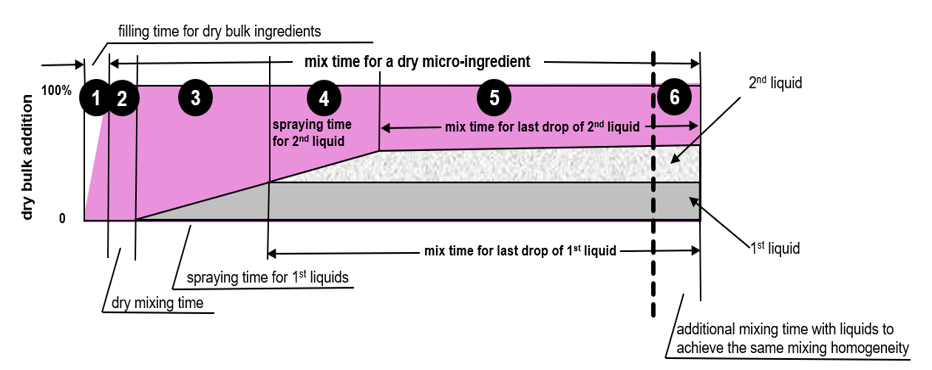
Initially, dry bulk ingredients are added to the mixer
(1) and subjected to dry mixing to create a uniform base mixture
(2). Addition of dry ingredients is a very short process which takes just up to 15 sec. because it can be prepared during mixing of the previous batch. The dry mixing time which takes up to 105 sec. is a crucial part of mixing to guarantee a homogeneous feed mix in the end. The required mixing time depends on the mixer configuration and equipment.
A sufficient distribution of dry ingredients must be achieved before liquid additives are added as the addition of liquids inhibits further distribution of dry particles. Therefore, high mixing homogeneity of the dry components in the feed must be established prior to liquid application. Consequently, initiating liquid addition earlier, to decrease overall cycle time, will negatively affect mixing homogeneity. Diagram 2. quantifies (expressed as CV = coefficient of variation) how uniformly a tracer nutrient is distributed in the final feed mix when liquids are added “just” after 30 sec, 60 sec or without any liquid addition.
Diagram 2
The CV expresses the variability of analytical results from multiple samples relative to the average concentration:

After adequate dry mixing, liquid additives can be applied via spraying systems (3, 4). Parameters such as droplet size, spray pattern, and spraying duration are critical for achieving uniform distribution and producing high feed quality.
In many feed mills, liquid additives are sprayed sequentially because dedicated spraying systems for each liquid are not available. Unlike dry ingredients, liquid additives cannot be prepared during the previous batch and must be added during the active mixing process. Consequently, increasing the number of liquid additives extends the overall mixing cycle due to the sequential spraying time required for each liquid.
Once sprayed, the liquid additives are absorbed by the dry bulk particles, allowing for even integration into the feed matrix. This process requires an additional wet-mixing phase (5), which can take up to 60 seconds, or longer depending on the overall proportion of liquids and mixer equipment.
The subsequent mixing phase (6) ensures that the absorbed liquids are distributed uniformly throughout the feed. Although the dry ingredients may already be well mixed, additional mixing time is required to achieve homogeneity of the liquid additives.
As a rule of thumb, each additional liquid additive can increase the total cycle time by approximately 15 seconds due to the combined effects of additional spraying and wet mixing time. Furthermore, liquid application requires careful process control to maintain overall throughput.
In contrast, dry feed additives can typically be dosed in parallel with the processing of the previous batch and do not require additional wet mixing.
Thus, replacing liquid additives with dry alternatives can improve overall throughput when mixing time is the production bottleneck. Evonik provides tools to quantify the potential economic benefits of this efficiency gain. Use the calculator below to estimate the profit increase that may be achieved by switching from liquid MHA-FA to dry DL-Methionine.
Calculate Your Profit Increase
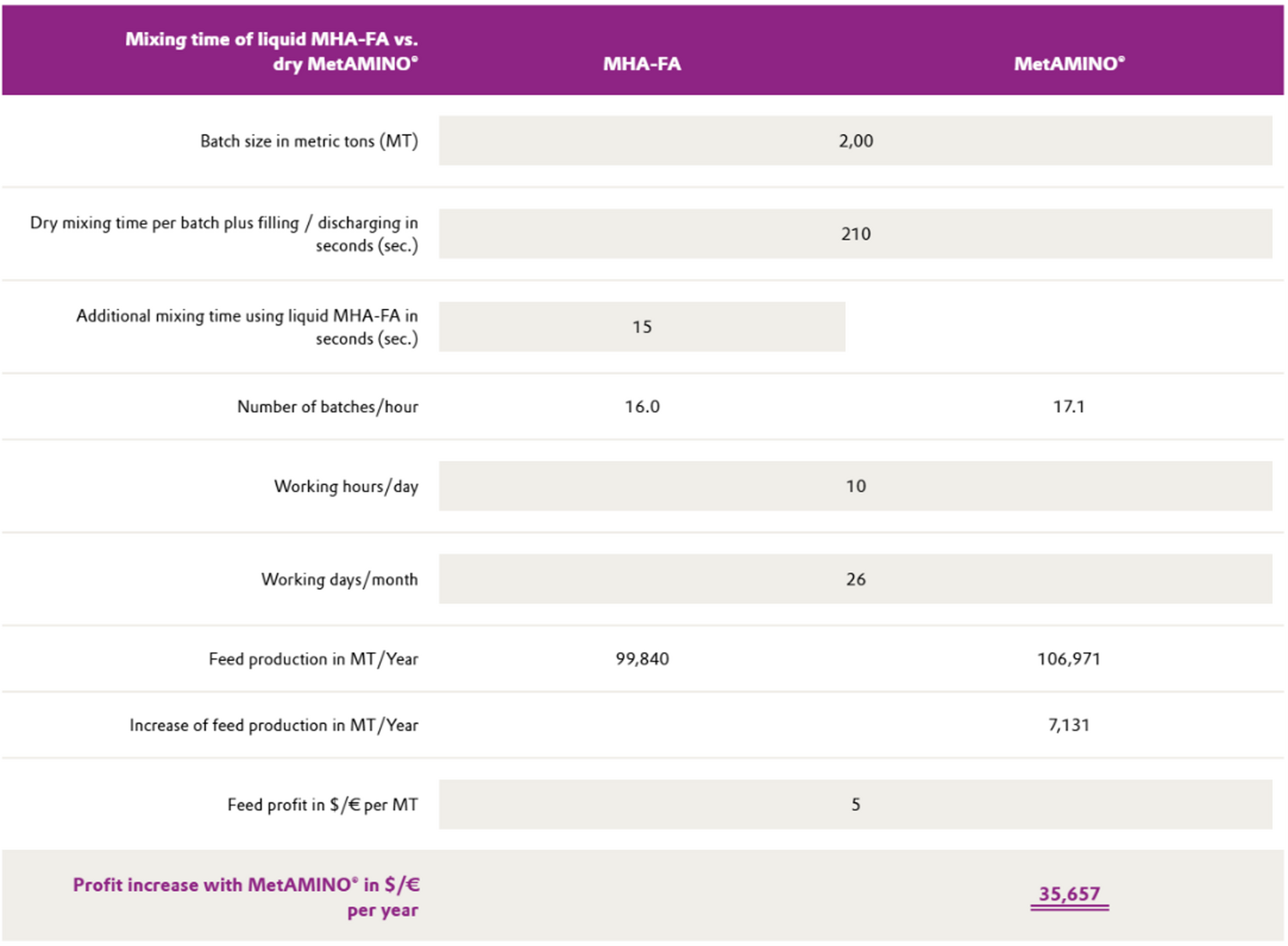
The example below illustrates a feed mill operating a 2-tonne batch mixer. The combined time for filling dry ingredients (1), dry mixing (2), spraying macro liquids (3), and wet mixing (4) is approximately 210 seconds per batch.
When another micro-liquid additive such as MHA-FA is included, an additional 15 seconds per liquid additive needs to be considered for proper spraying and wet mixing time. Vice versa, eliminating an additional liquid can reduce the total cycle time by approximately 15 seconds per batch.
When another micro-liquid additive such as MHA-FA is included, an additional 15 seconds per liquid additive needs to be considered for proper spraying and wet mixing time. Vice versa, eliminating an additional liquid can reduce the total cycle time by approximately 15 seconds per batch.
In below example, the cycle time can be shortened by 15 seconds when switching from liquid MHA-FA to dry DL-methionine (MetAMINO®). In turn, the number of batches per hour increases from 16 with liquid MHA-FA to 17,2 with MetAMINO®. This increase in batches per hour results into an additional profit for the feed mill of $ 35,657 per year when calculating with 10 working hours per day, 26 working days per month and an assumed profit of $ 5,00 per metric tons of feed. In sum, the additional profit is derived from higher production output from 99,840 MT/Year to 106,971 MT/Year resulting from improved mixer utilization.
The content of this document is for the information and assistance of Evonik’s customers and is not applicable to products marketed or sold in the United States. Evonik markets its products in compliance with applicable local laws, but it is the user’s responsibility to ensure that the use of and any claims made for this product comply with all relevant requirements. This document may not be published in the United States without the express written consent of Evonik Operations.